
about the Project
STEAM-CT
STEAM-CT
STEAM-CT is an international project co-financed by the Erasmus+ Program of the European Commission with partners in Germany, Austria, Greece and Portugal.
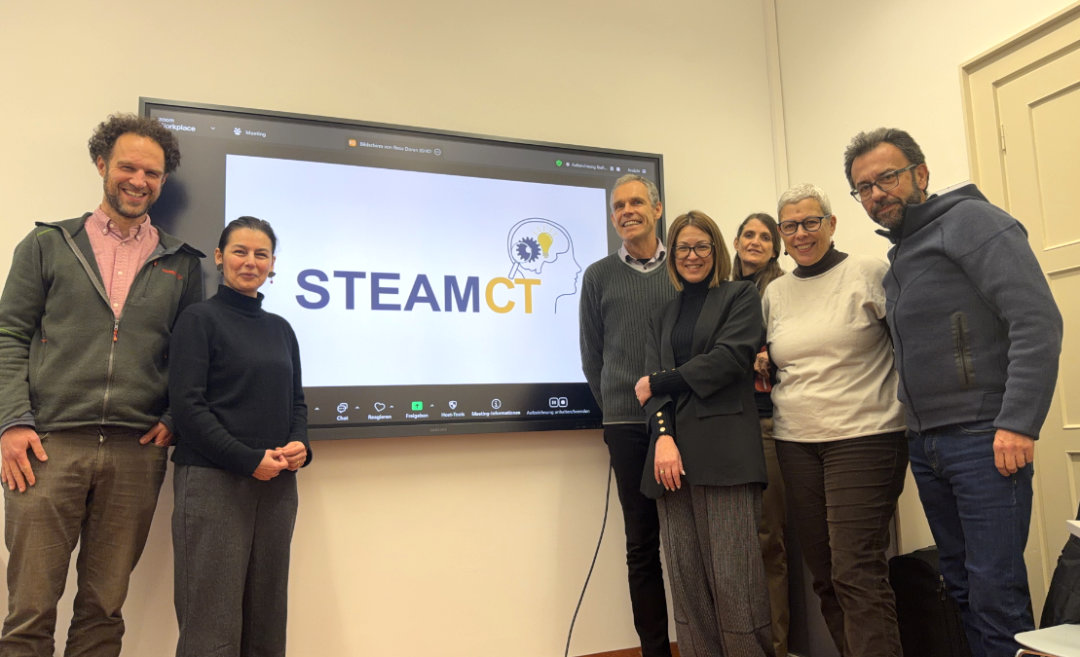
The project enhances teachers' ability to design and implement integrated Critical Thinking (CT) STEAM lessons. It offers targeted training for pre- and in-service teachers, enabling seamless CT integration into regular teaching. The initiative drives innovation in teacher training at the higher education module level and supports effective CT-STEAM lesson implementation. It also includes a performance assessment framework and an e-learning platform with tutorials, ensuring continuous learning and skill development.
During the project, the team aims to develop diverse CT-integrated STEAM lessons with performance assessments. Teacher training with guided instructions will support teachers’ competency development to integrate CT into everyday teaching. Iterative training throughout the project using a design-based research approach will ensure high-quality instruction. Additionally, the project will publish recommendations for curriculum adaptations in teacher training programs.
To ensure maximum reach and impact, the project will create an e-learning platform with tutorials, a handbook for integrating CT across subjects, and a competency framework outlining key skills for implementing CT in everyday teaching. It will also establish a network of educators for collaboration and provide exemplary CT lessons.
Meet Our Partners
Dresden University of Technology
Technische Universität Dresden (TUD) is one of eleven German universities that were identified by the German government as ‘Universities of Excellence’ and are thus entitled to receive permanent funding within the framework of the Excellence Strategy of the Federal and State Governments. TUD is one of the largest technical universities in Germany and is among the country’s leading and most dynamic universities. With 17 faculties in five Schools, TUD offers a broad variety of degree courses and covers a wide research spectrum. Having been committed to sciences and the engineering before the reunification of Germany, it has nowadays become a university that unites the natural and engineering sciences with the humanities and social sciences as well as medicine. TUD has about 29.000 students and 8.300 staff members – among them about 600 full professors – and, thus, is the largest university in Saxony today. TUD is embedded in the DRESDEN-concept network, which bundles and uses all synergies of Dresden’s numerous scientific and cultural institutes. The exceptional international outreach of TUD is backed by a long history of cooperation projects in research and education. Many of these projects are being funded by the European Commission and make out an important share of third party funding at TUD in general, which amounted to more than 360 Mio. EUR in 2023 – almost half of the total university budget. Teacher education has a long tradition at TUD, the pre-service teachers are the largest group of students at the university. The program’s international dimension is evidenced by over 60 global partner institutions, many Erasmus+ partnerships, and unique initiatives like IMPRESS and the international school network, which provide students with unmatched opportunities for global teaching experience and intercultural competence.

University College of Teacher Education Tyrol
Empowering Educators, Inspiring Learners - Shaping the Future of Education.
The University College of Teacher Education Tyrol, based in Innsbruck in the Alps, stands as a leading centre for educational excellence and innovation in Western Austria. Its mission focuses on delivering evidence-based, practice-oriented, high-quality training for future educators. The institution views education as the foundation of a thriving society and actively contributes to shaping the educational landscape through research and innovation. It functions as a dynamic hub where academic theory meets real-world classroom experience. PH Tirol offers a broad range of Bachelor’s and Master’s programmes covering primary and secondary education, vocational training, and elementary pedagogy, all ddesigned to meet the evolving needs of the 21st-century classroom. Its research focus—ranging from educational sciences to digital innovation and inclusion—is built on a foundation of "Evidence, Innovation, and Effectiveness. The university also promotes continuous professional development through lifelong learning opportunities, including specialised training in leadership, school development, and digital literacy. Alongside this, it embraces an international outlook, fostering global exchange through partnerships such as Erasmus+, and welcoming students and staff from around the world. Its core values centre on quality, responsibility, and creativity, with a strong commitment to effective learning methods, responsible innovation in addressing contemporary educational challenges, and practical development tailored to real-world teaching-learning settings.

Science View
Founded in 2008, Science View is a non-for-profit organization that promotes science communication and science education activities as well as social inclusion to help bridge the gap between the scientific community and the wider public in Greece and in Europe. The staff, members and co-operators (science communicators and science journalists) of Science View, are constantly working on making scientific knowledge useful and clearly understood by the general public. Science View involves a network of almost 250 members from several fields (e.g. , scientists, teachers, communicators) and partners with large EU projects and aims at expanding events and activities organized in Greece to the rest of Europe. The activities that Science View develops, implements and is involved in are in line with all aspects of Responsible Research and Innovation, science education, public engagement, open access to scientific information, gender equality, social inclusion and ethical issues represent the main pillars and guiding principles of the organization. Still, in the upcoming five years Science View aims at enlarging its involvement in RRI and science communication in general, hoping to increase the integration of society and its citizens into research processes and also contribute to the increase of the uptake of STEAM related academic and professional careers. Science View’s strong devotion to RRI principles; its longstanding experience in science communication and in the development of transdisciplinary approaches in science education makes Science View a valuable and skilled partner. Its proficiency stems from the organization and conduct of various EU-funded projects, having borne responsibility as a work package leader, task leader or national organizer as well as running the administration office of large-scale projects.

Global Hands-On Universe
Global Hands-on Universe Association (GHOU) was created in 2008 as a non-profit association by a worldwide network of astronomers, scientists, and educators. It was created as a continuation of the Hands-on Universe initiative which was born in 1994 in the USA and gained international recognition. GHOU’s mission is to promote deeper understanding, based on evidence, of our place in the Cosmos through teacher training and innovative educational projects. The association also focuses on the use of modern tools and resources for science education and in the engagement of students in international scientific projects. GHOU promotes global cooperation, namely through the promotion of the annual conference, open to all interested in taking science research into the hands of students worldwide.